Emerging Tech Resources
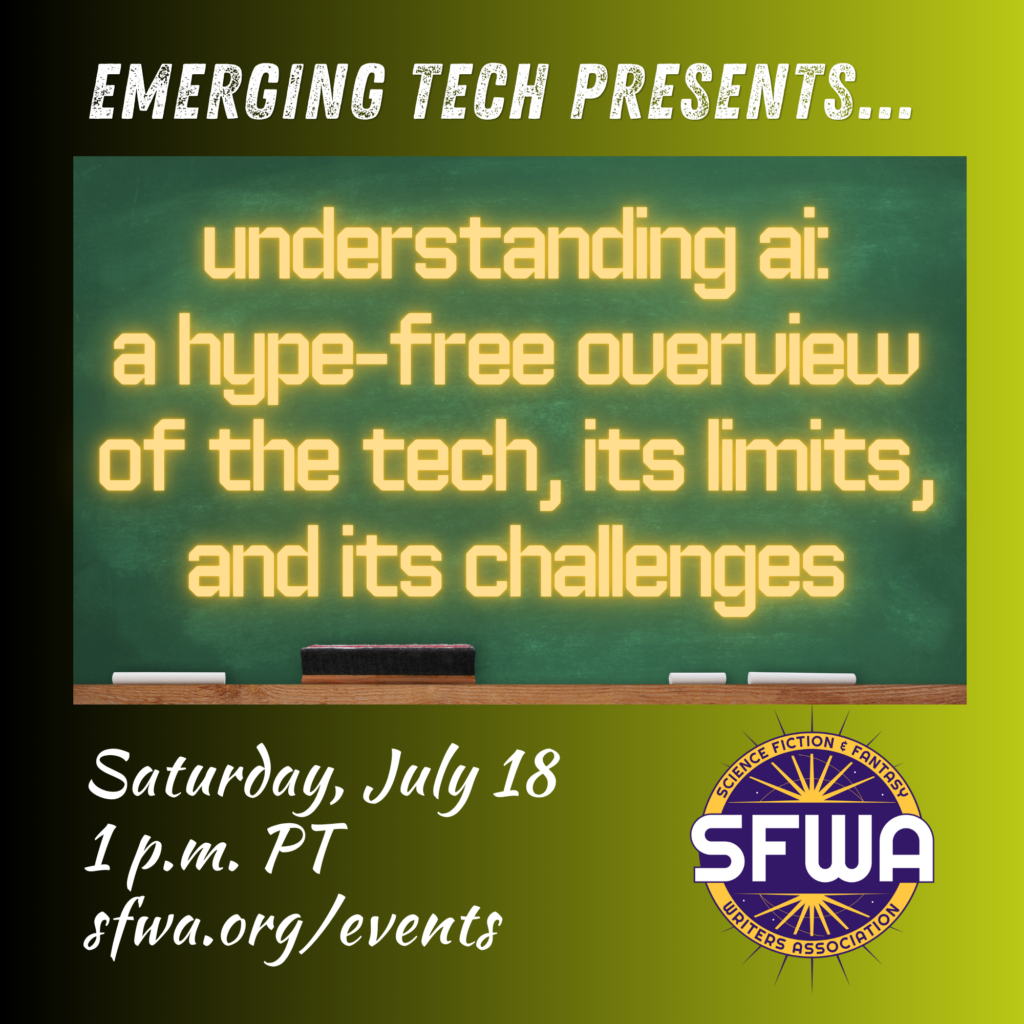
On Saturday, July 18 at 1pm Pacific Time, we are honored to present “Understanding AI: A Hype-Free Overview” to SFWA Members and RSVP’d members of the general public. Together, we’ll look at what AI is and isn’t, what it can and can’t do, its limits, and the challenges it poses for creators. If you have any questions or concerns for the Emerging Tech team to review during that panel, please fill out the form below ahead of the event!
Full Synopsis:
“AI” is everywhere these days, both in familiar software and in the discourse. In a lot of quarters, you’ll hear claims that it will inevitably take over all jobs, that it will be able to do everything, and that those who don’t use it will swiftly fall behind. Many creators want to resist these trends, or play with new tools at their own pace, but face pressure from employers and trouble navigating opt-out settings.
This SFWA Emerging Tech panel offers a hype-free discussion of how large language models work, and debunks some common areas of confusion. We’ll talk about what they’re good at, what they’re likely to remain bad at, where they harm creators, and the risks involved with using them. And we’ll talk about the difference between chatbots and non-generative AI methods.
Our goal is to help attendees make mindful decisions about what role (if any) you want AI to play in your work, enforce those boundaries with employers and in software settings, and have something coherent to say to friends who “just asked ChatGPT.”
Introduction and Framing
Artificial intelligence raises many questions for science fiction and fantasy writers and publishers. Publications are overwhelmed by “slop” submissions. Authors endure pressure to prove that their work is human, while also scrambling to figure out where AI has been inserted into common software and what they risk by experimenting with new capabilities. All of us are trying to figure out how to make careers from human creation in this environment.
SFWA’s Emerging Tech committee exists to share guidance with creators who are trying to navigate this rapidly changing domain. We are aligned with the SFWA Board’s AI Working Group in the importance of empowering human creators. Our goal is to provide resources that meet creators where they are, and to support working in the ways that you want to, rather than those set by corporate default.
This page offers initial reference materials and guidance, but should never be taken as an end to the conversation. We are engaged in a living industry, which will routinely require updates and discussion. We welcome your product updates, experiences, and questions as we develop a resource guide with long-term value.
Who is on the Emerging Technology Committee?
The committee is led by chair Ruthanna Emrys and co-chair Kenna Alexander, and includes Casey Berger, Ben Curtis, CB Droege, Andrew Harvey, Luis Enrique Torres, Rick Wagner, and Risa Wolf. We receive regular support and input from M.L. Clark, Anthony Eichenlaub, Michael Capobianco, and Misha Grifka Wander. We have also been working closely with Joyce Reynolds-Ward and Bert-Oliver Boehmer from the Independent Authors Committee, and we are open to input from other volunteer committees, wherever these technologies intersect with concerns advanced by other creators.
What is the committee’s mission?
SFWA’s Emerging Tech Committee was assembled to help SFWA and the broader genre community meet the rapid speed of technological evolution with thoughtful and considered approaches to the work we do as creators. We exist to support our membership with information about the implications of new and current technology for their work, to encourage organizations to be more aware of how their technology can create new challenges for authors and artists, and to provide a resource to educators, students, and readers also navigating our current technology environment. We embrace all professions of relevance to SFWA (i.e., connected to publishing in science fiction, fantasy, and related genres) in our research and recommendations.
Our primary goals are to:
- Monitor and assess technologies with the potential to impact the publishing industry, across traditional, independent, and self-published works, and across international; concerns, or to affect the rights, opportunities, and work of individual authors and artists.
- Update the wider SFWA Board, membership, and public audiences on said technology and possible evolutions thereof;
- Recommend policies and support SFWA practices that will preserve the rights of authors and artists relating to the above, including but not restricted to contract rights, financial rights, and accessibility rights.
We are aware that technology access and regulations thereof are wildly different across global lines as well as accessibility lines, and we commit to including both an international perspective and an accessibility perspective in our work.
Where can I learn more?
The committee will lead a virtual panel at the Nebulas on “Opting In, Opting Out: Making Human Choices About AI in Writing Software.” We are also planning a series of webinars over the summer, which are open to educators, students, and general readers as well as writers, since all four demographics are often under pressure to integrate AI into their work, academic, and everyday experiences.
What are you working on?
- Collaborative discussion with SFWA leadership and the SFWA Board AI Working Group
- Guidance for finding and customizing AI and security settings in common writing software
- Transition support for those seeking tools that are pro-human, open-source, privacy-focused, or otherwise a better match for their needs.
- Exploration of issues around accusations of authorial AI usage, including the various tools and certifications that claim to detect AI usage and/or confirm human creation.
- Resources for publishers and award programs
- Resources for educators and students, ideally for use in classroom discussions
How can I get in touch?
Use the form at the bottom of this page! It covers a wide range of feedback, including for upcoming analysis tools on this page. General thoughts, questions, and concerns are also welcome, as are requests to participate in this project.
“AI” is not the artificial intelligence imagined in older science fiction. It has become the catch-all term for most machine learning, which is a statistical process of transforming some elemental fact (e.g., this word, or that pixel) into something akin to relative meaning.
Of particular relevance to people working in the storytelling ecosystem, LLMs or “large language models” transform training sets made of vast amounts of text into statistical records called models. Embedded in these models are how every word in every text relates to every other word, and this “relative meaning” allows AI systems to approximate an understanding of a user’s prompt with just math and pattern matching. LLMs do not store or check facts – their output is based on the frequency with which words and phrases appear near each other in the training data.
A type of AI called generative AI can then create a response that has a derived complementary meaning, such as something that looks like an answer if the prompt was a question. Models do be trained on facts, but since generative AI responses are tied to statistical comparisons, they will often fabricate data or create false responses (sometimes called “hallucinations”) presented confidently alongside factual answers.
Training these models has a high financial, environmental, and social cost, which is why most models are sold to consumers with the promise that the effort of creating “something close enough” will yield more labor-saving and/or productivity gains over time and with fuller industry adoption of related processes and products.
Many content creators who rely on recommendation algorithms to put their work in front of consumers will use generative AI to produce large volumes of low-effort slop, expecting a fraction of it to go viral. These creators run the risk of de-skilling, or losing their ability to create or discern quality content, in a process called cognitive surrender.
AI companies may design their AI tools with the intent of helping their customers, but if the consumer becomes dependent on AI to complete their tasks, the result is an economic misalignment unfavorable to the consumer. “AI alignment” generally relates to training and governing the AI system to take human ethical guidance into account in outputs.
This is a field of active study within AI companies, but disagreement is widespread even among humans about what principles should be included, and implementation varies in effectiveness. Similarly, AI Safety work often falls short of goals for avoiding harmful output. AI companies continue to receive criticism, lawsuits, and close scrutiny for negative impacts on mental health, the ease with which testers circumvent constraints, and production of misinformation.
Some AI technologies avoid the alignment problem by focusing on narrow applications, such as assistive technologies, that help people suffering from sensory or cognitive limitations, dysphoria, or have difficulty picking up social cues.
How does LLM training draw from authors’ work, and what are the legal implications?
Large language models are trained on large sets of text data. For most corporate models, this data includes copyrighted or otherwise IP-controlled text that has been used without the creator’s awareness, either without IP-holder permission or because permission might have been provided by the copyright holder.. Recent contracts should clearly cover treatment of AI-related uses, but some may be ambiguous. Some models also use pirated rather than purchased books and articles. IP-compliant and consent-based/opt-in training is hypothetically possible, but corporate LLM developers generally claim that such an approach to developing training sets is not practical.
Legal decisions to date have tentatively treated the training of AI models on legally acquired work as “fair use”, but there are a number of pending cases on this question. See here for SFWA’s current actions to protect author IPs, information about pending cases, and how they may affect you as an IP-holder.
Do I need to worry about my copyright when using tools that integrate AI for creation?
Current precedent is that AI-generated art in which the only human input involves prompts is not copyrightable. However, human creations made with AI involvement can still be copyrighted.
If you are generating words or art yourself on certain software programs, the software company may still introduce IP issues for your work via End User Agreements. Many operating systems, programs, and apps that have End User Agreements allow the use of all user data in future AI training. Such agreements sometimes include additional IP claims, which cover both training sets and the later production of identical or similar output.
SFWA’s Emerging Tech committee is developing a database of software tools that will track this type of risk and offer guidance for creator-friendly settings and alternate, lower-risk tools. It is more important than ever for creators to be informed about the types of agreements they are tacitly making with common writing and publishing tools in the course of their creative work.
How does SFWA approach different kinds of AI/LLM use by creators?
As a matter of policy, SFWA supports and encourages human creation over AI generation, and is a strong advocate for greater education and empowerment in this realm. Writer advocacy includes support for markets and awards requiring human artistic generation, deeper awareness of the tools in use by creators everywhere, and a preference for software and systems that allow human users to easily make their own creative choices. A full statement is available here.
However, AI/LLM is integrated into software in a number of ways, and not all uses are equally an impediment or replacement for human creativity. The following are categories are used by the EmTech committee and offered as a framework for further conversation:
- AI-generated text is created or translated by an AI-based tool. If you used an AI-based tool to create some or all of the actual words, it is considered “AI-generated” even if you applied substantial edits after. This category is forbidden by many markets and it is disqualifying for many awards, including the Nebula Awards, in part because the training sets for these models have used data from copyrighted materials without adequate compensation and/or consent. To protect your own work from inclusion in such training sets, it is often possible to negotiate for a no-AI-writing clause (e.g., for publicity text) in your industry contracts. Please refer to SFWA’s Contracts Committee to learn more.
- AI-generated visuals use text-to-image compilers to draw images from a prompt. Dall-E & Midjourney are examples of subscription-based cloud services that use this technology. If you used an AI-based tool to create some or all of an image, it is considered “AI-generated” even if you applied substantial edits afterwards, or if the AI is creating on top of substantial original work. This category is forbidden by many markets and disqualifying for many awards, in part because the training sets for these models have used data from copyrighted materials without adequate compensation and/or consent. To protect your own work from inclusion in such training sets, it is often possible to negotiate for a no-AI-writing clause (e.g., for cover art) in your industry contracts. Please refer to SFWA’s Contracts Committee to learn more.
- AI-edited text describes content that was created in draft form by a human, then modified or revised using an AI-based tool. This is a significant site of concern for writers who use grammar- and spell-check software, but there is an important difference here. Content is considered to be AI-edited if words or phrases generated by the AI appear directly in the final, published version of the text, along with words or phrases created by the human author. This category is forbidden by many markets and disqualifying for many awards, including the Nebula Awards. If the AI only provides indirect writing assistance, like suggesting a different spelling or verb tense, then it falls into the AI-supported category.
- AI planning describes the use of AI to help plan a work without contributing text on the page. This may include using AI to outline a book, plan content for chapters, provide character descriptions, or carry out and summarize research that feeds into content. AI planning is discouraged by many writing groups, and this use case is under active discussion for inclusion in the “no AI” declarations that an author has to make for their work to be considered, say, eligible for the Nebula Awards or participation in a SFWA promotions vehicle like NRN, G&CQ, and NetGalley. Check the wording on any “no AI” declaration you make on SFWA.org or with other literary venues before proceeding.
- AI suggestions offer feedback for how to change wording, plot, and format, but final changes are made by a human and do not involve copying AI output. AI suggestions are more advanced than simple grammar- and spell-check suggestions, for which reason they are still discouraged by many writing groups. At present, this may be disqualifying for some markets, so always review any “no AI” declaration on a service you wish to use on SFWA.org or with other literary venues before proceeding.
- AI-supported is an umbrella term that describes any work where all words or phrases in the final, published version of the text were created by a human, but an AI assisted in the writing process in some other way: for example, in brainstorming, generating ideas, or checking for errors. This larger category includes AI planning, AI suggestions, and proofreading, and a “no AI” declaration may use this larger term in a way that requires the author to follow up with the issuing organization or service for clarity.
- Text-to-Speech and Speech to-Text depends on machine learning for high-quality transformations. Speech-to-text tools have long been established as a writing method for both accessibility and personal preference reasons. As long as the words are being created by humans, this is not considered AI-generated text. Similarly, voice-to-voice functions (i.e., changing a recorded voice to sound different) is not considered AI-generated text. Text-to-speech is also used for accessibility purposes, but for commercial audiobooks, SFWA strongly encourages the use of paid human readers.
- AI Proofreading is used to check spelling, grammar, and punctuation after writing. Unless this involves replacing human-generated sentences with substantial AI results, this does not fall under AI generation and is not considered problematic.
What methods are publishers and awards using to enforce AI policies?
At the moment, most publishers and awards ask only for self-attestation by creators, in the form of “no AI” declarations that they have not used AI in ways excluded by a given organization’s policies. Publishers and other literary organizations may also use surface indications of AI generation to form their own judgments. This is less likely to involve commonly cited “AI indications” like em-dashes, and more overarching commonalities across AI-generated work.
SFWA urges markets to use caution with “AI checker” tools, which have high rates of false accusations, often feed the text they evaluate into further AI training sets, and can be countered by poor-faith submitters of AI-generated work, who may use the results of such services to develop harder-to-catch text.
There is also an international component to consider when relying on an AI checker to detect AI use: different language contexts favor different structural norms (e.g., some cultures are more circular in their writing styles than others). The writing of non-native speakers can raise red flags for the wrong reasons, which can only be countered by editorial teams proactively considering global variations when evaluating any given work.
How does SFWA approach different kinds of AI/LLM use by creators?
As a matter of policy, SFWA supports and encourages human creation over AI generation, and is a strong advocate for greater education and empowerment in this realm. Writer advocacy includes support for markets and awards requiring human artistic generation, deeper awareness of the tools in use by creators everywhere, and a preference for software and systems that allow human users to easily make their own creative choices. A full statement is available here.
However, AI/LLM is integrated into software in a number of ways, and not all uses are equally an impediment or replacement for human creativity. The following are categories are used by the EmTech committee and offered as a framework for further conversation:
To date, the honor system is most commonly used among publishers or awards. Reckoning Press and Bona Books, among others have recently discussed their human-centered processes for addressing potential AI writing. AI content analysis is frequently used in educational settings, and the growth of AI training sets from such materials continues to make human verification complex.
Matrix data currently unavailable.
Which common tools incorporate AI, and what functions does the AI provide? Is there a way to opt out of AI use in this software?
SFWA’s Emerging Tech committee is working on a database that creators and publishers can use to learn about risks (AI, data, privacy) in common software, how to change settings toward your preferred level of usage, and potential alternative tools for those considering switching. We expect to launch an initial minimum-viable-product version covering word processors, search engines, browsers, and grammar checkers in August 2026.
However, this is a rapidly-changing area, in which software companies regularly roll out new features and opt-in/opt-out requirements with little advance warning. The database will be open to user input, and we will be actively encouraging product updates, to stay current.
In the workplace, policies also change quickly and range from forbidding use to requiring it. Emerging Tech is planning a set of summer webinars for educators and students, along with general readers and writers, trying to navigate and/or negotiate such requirements.
What is SFWA doing about AI and other emerging technology issues?
Emerging Tech is a volunteer committee dedicated to developing resources for writers, publishers, and educators who want to tailor software settings to their own needs, particularly around AI, privacy, and data collection. As we roll out these resources for public use, we will be looking for input from key stakeholders to identify education priorities and to keep listings up to date.
Writer Beware has been tracking issues around AI and copyright.
What are other writers’ organizations doing about AI and other emerging technology issues?
The Authors’ Guild has created a Human Authored certification program to label human-created works. They are also involved in legal and policy advocacy. See here for details on their work.
SFWA is a member of the Authors Coalition, a coalition of 23 creators’ organizations. The coalition holds a monthly AI Forum call to discuss AI matters of mutual concern, including contractual language and ethical standards for AI use. Virtually every organization is working on defining best practices for the use of AI, but without a broad consensus. The primary impetus for many of the groups (including the Authors Guild) is to create an opt-in collective licensing system for the use of copyrighted work, similar to the way ASCAP licenses musical performances. This includes lobbying for the necessary federal legislation.
The Creators Coalition on AI addresses similar issues from the standpoint of the entertainment industry, including screenwriters. Hollywood actors have been building a Human Consent Framework for AI use of images and creative works.
What legal actions are in progress around permission-less training of LLMs on creative work? How can I opt into or out of class action suits?
The SFWA Legal Affairs Committee tracks the Anthropic Class Action Settlement and other legal actions involving AI here. The Fairness Hearing for the Anthropic Settlement will be held on May 12, 2026 and if it is approved it will be used as a model for a growing number of similar settlements across the AI industry. In addition to the US, lawsuits in Canada and the EU are at an early stage but promise settlements that aren’t limited to works with US copyright registration. The best website to keep up with the quickly changing landscape is currently the AI Litigation Tracker at ChatGPTisEatingtheWorld.com.
What are people doing about these issues beyond authors’ associations?
There are several movements in tech development, policy, and user advocacy around alternatives to corporate software. Some examples include:
- Free and Open Source Software (FOSS) – open, modifiable code; often free or low-cost alternatives to for-profit software.
- Public Interest Technology – movement to develop tech alternatives with public funds, with public input and control, and for the public good.
- The Neoluddite Movement – pushing back on formal and informal requirements to use specific tools.
- Right to Repair – Advocates requirements for hardware that users can easily fix and modify; supports companies building tech that meets these requirements.
Materials at the following links are not vetted or endorsed by SFWA, but include content that EmTech committee members have found useful and relevant.
AI in Publishing
Jane Friedman’s AI & Publishing Legal FAQ: https://janefriedman.com/ai-and-publishing-faq-for-writers/
Australian Authors Push Back Against AI Theft: https://globalvoices.org/2026/04/09/australian-creatives-push-back-against-ai-theft/
Kobo: “Plutonium or Salt? When It Comes to Books, How Much AI is Too Much?”: https://publishingperspectives.com/2026/06/plutonium-or-salt-when-it-comes-to-books-how-much-ai-is-too-much/
General Tech Use and Policy
Building Civic Strength for an AI Era: https://datasociety.net/points/building-civic-strength-for-an-ai-era/
Points of Leverage for More Human-Friendly AI: https://metagov.org/cg-ai/
Breaking Free: Pathways to a Fair Technological Future (Norwegian Consumer Council Anti-Enshittification Report): https://storage02.forbrukerradet.no/media/2026/02/breaking-free-pathways-to-a-fair-technological-future.pdf
Tools for Evaluating Personal Tech Use: https://otherworldscatalog.com/p/how-i-disconnected-from-tech-in-2025?r=3liuk&triedRedirect=true
Olivia Guest’s Critical AI Literacy page: https://olivia.science/ai/
Alternatives and Setting Recommendations for Specific Tools
Privacy-prioritizing Alternatives to Common Software: https://www.glitcharmour.org/
Europe-based Software Options: https://european-alternatives.eu/
Open Source Alternatives to Proprietary Software: https://opensourcealternative.to/
Open Source Word Processors: https://sourceforge.net/directory/word-processors/windows/
Digital Public Goods Registry (includes listing of alternate software and platforms): https://www.digitalpublicgoods.net/registry
Removing AI from Gmail: https://opus.ing/posts/how-to-remove-ai-overviews-gmail
Firefox AI controls: https://support.mozilla.org/en-US/kb/firefox-ai-controls
How to Disable AI Features in Chrome Browser: https://www.thewindowsclub.com/how-to-disable-chrome-ai-features-on-pc
How to Disable AI in Microsoft Office 365: https://support.microsoft.com/en-us/office/turn-off-copilot-in-microsoft-365-apps-bc7e530b-152d-4123-8e78-edc06f8b85f1
SFWA Emerging Tech Questions and Requests Form
An ongoing space for members of the community to ask questions, share doubts, offer corrections, and present ideas to the Emerging Tech volunteer team and the broader SFWA Advocacy Working Group.
For more information, or if you would like to contact the EmTech Committee please fill out the contact form above.